Multi-THuMBS: Multi-person Tracking of 3D Human Meshes Beyond Video Shots
1UNIST Vision and Learning Lab, UNIST 2University of Birmingham 3CJ Corporation



ECCV 2026
TL;DR Multi-THuMBS preserves identity-consistent multi-person 3D human mesh tracks across abrupt shot changes by aligning boundary frames in a shared 3D space.
Interactive Results
Drag to rotate, scroll or pinch to zoom, and pick a sequence below.
Abstract
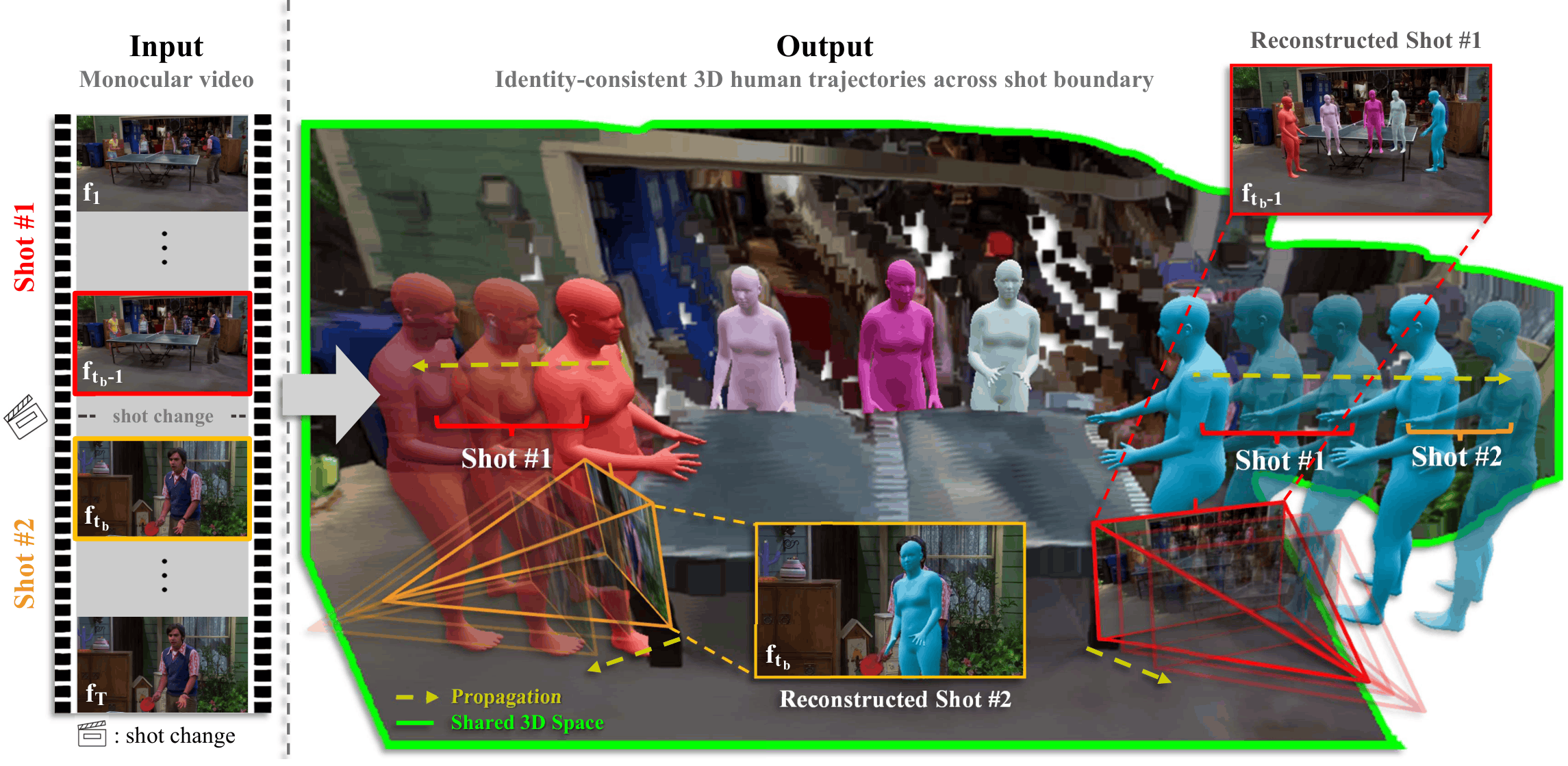
Tracking multi-person 3D human meshes from in-the-wild videos is challenging due to complex interactions, frequent occlusions, and severe truncation in unconstrained environments. While recent approaches have improved robustness against these issues, they largely overlook the critical challenge prevalent in real-world footage: frequent shot changes. Abrupt viewpoint transitions can break identity tracking and temporal trajectory consistency, and existing shot-aware mesh tracking methods remain largely limited to single-person scenarios. To address this gap, Multi-THuMBS reconstructs the boundary frames around each shot change in a shared 3D space using a 3D scene prior, then registers human meshes in that space to preserve per-person identity and motion consistency across shots. Experiments show improvements in 3D mesh recovery, camera pose estimation, and identity tracking over prior methods, yielding temporally coherent multi-person reconstructions across shot boundaries.
Contributions
-
Multi-person tracking across shots
To our knowledge, the first method to extend multi-person 3D human mesh tracking to multi-shot videos. A learned 3D scene prior builds one shared 3D space for adjacent shots, where each person's trajectory is connected.
-
Geometry-aware re-identification
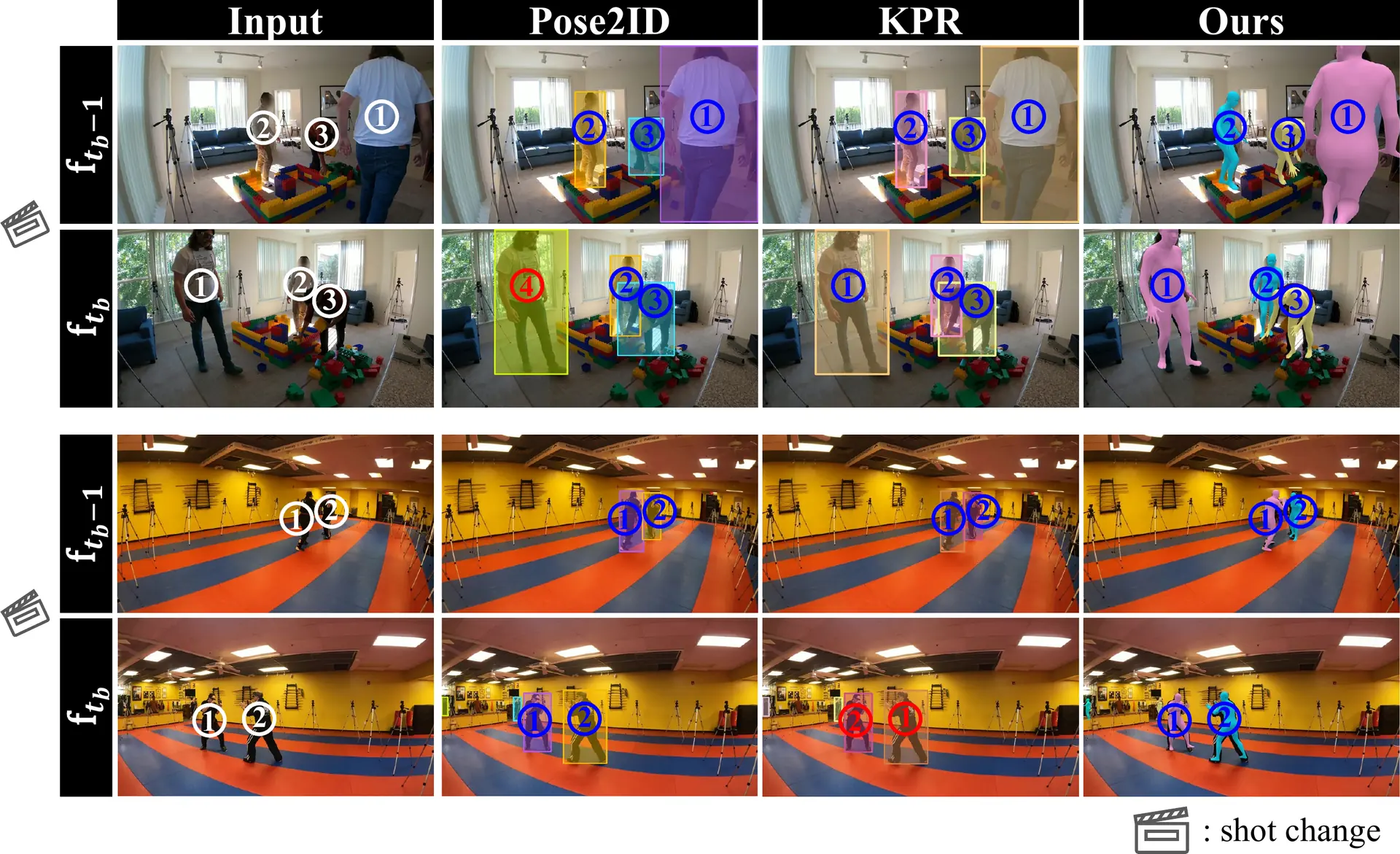
People are matched across the cut by 3D distance, pose, and appearance together, so identities hold even when the viewpoint and appearance change abruptly.
-
Global spatiotemporal optimization
Joint trajectory smoothing and a cross-camera reprojection loss stabilize poses, correct residual misalignment, and keep motion consistent across shots.
Why Shot Changes Are Hard
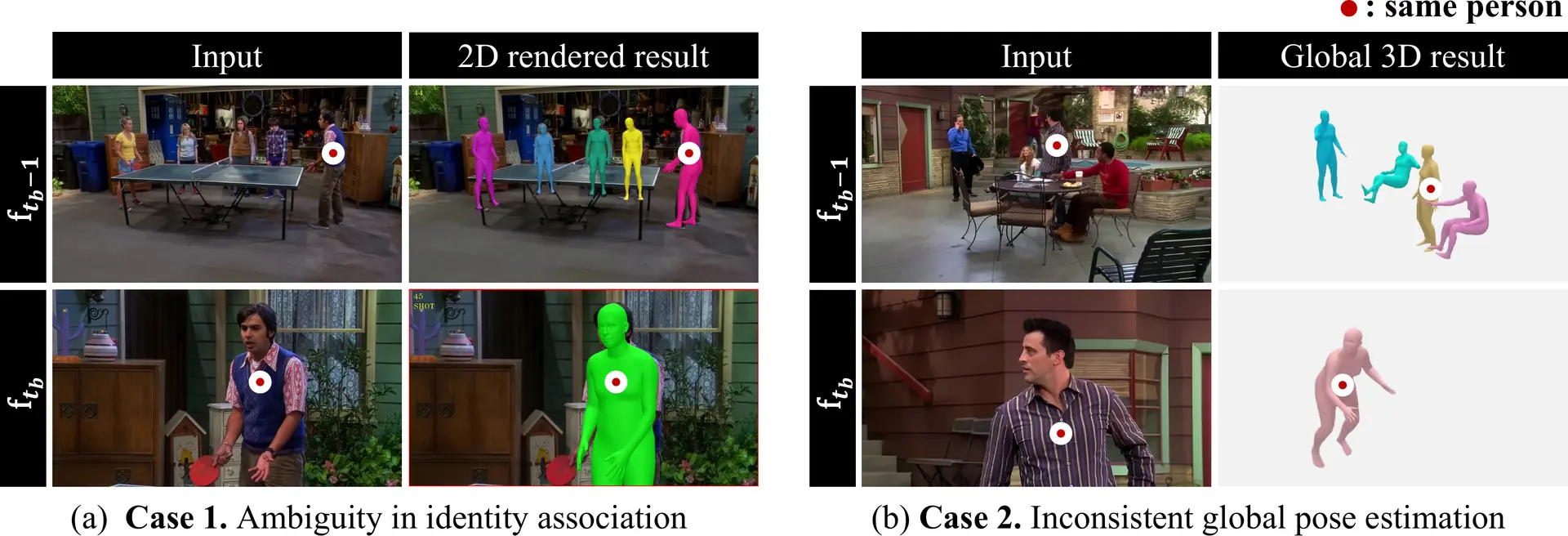
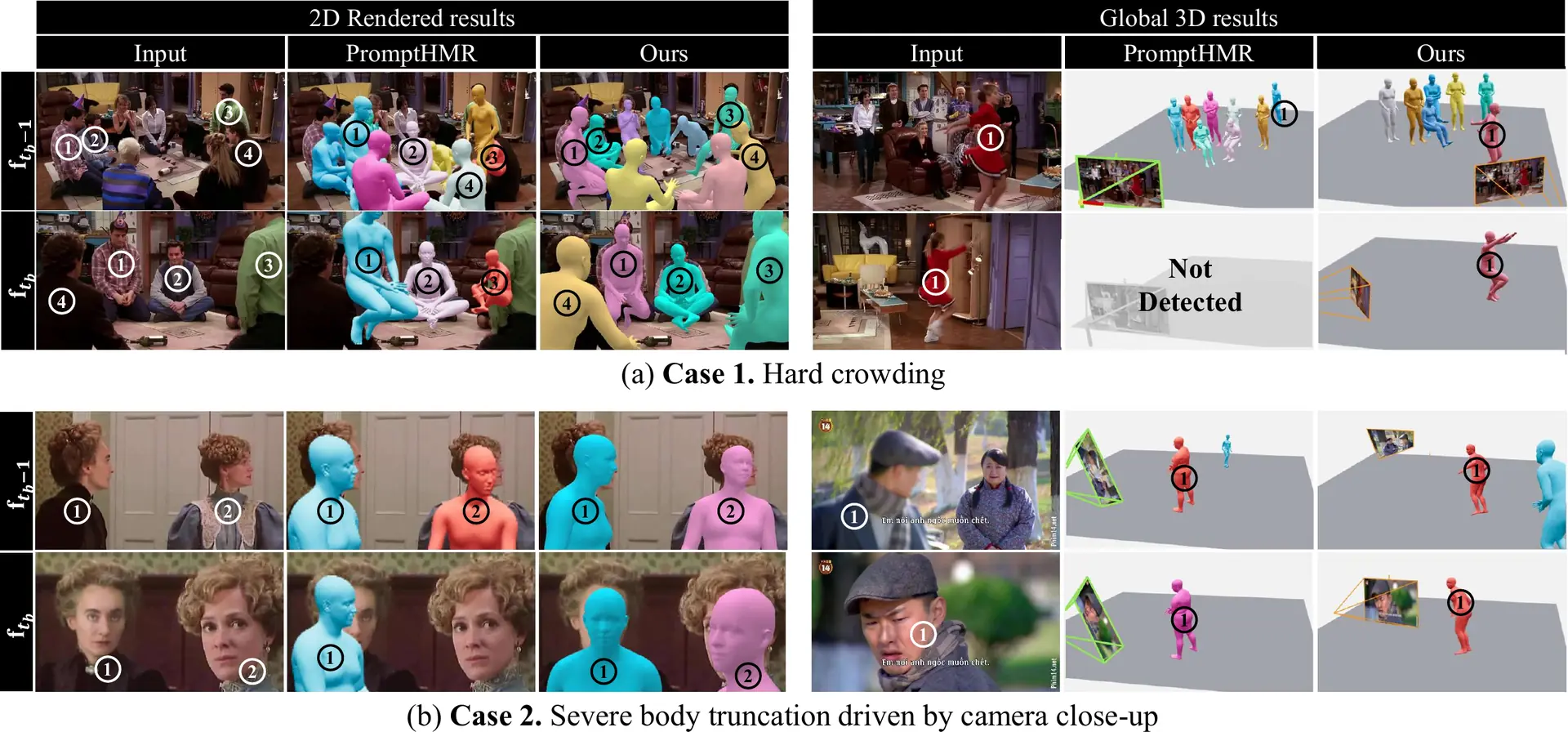
Films, broadcast sports, and edited online videos are made of many shots. Current multi-person trackers assume the camera moves continuously within one shot, so at every cut they lose identities and misplace people in 3D.
-
Appearance changes abruptly
A new viewpoint changes how everyone looks, so appearance-based re-identification fails to keep identities.
-
The camera jumps
The camera position changes suddenly, so meshes from the two shots are no longer globally aligned.
-
People come and go
The number of visible people can change at the boundary, which makes identity association ambiguous.
Method
Given a video split by a shot boundary, Multi-THuMBS first estimates human meshes and camera poses for all frames. It then builds a A shared 3D space from the boundary frames, B aligns meshes across shots, C propagates camera and mesh trajectories, D links identities using spatial, pose, and appearance cues, and applies E temporal smoothing.
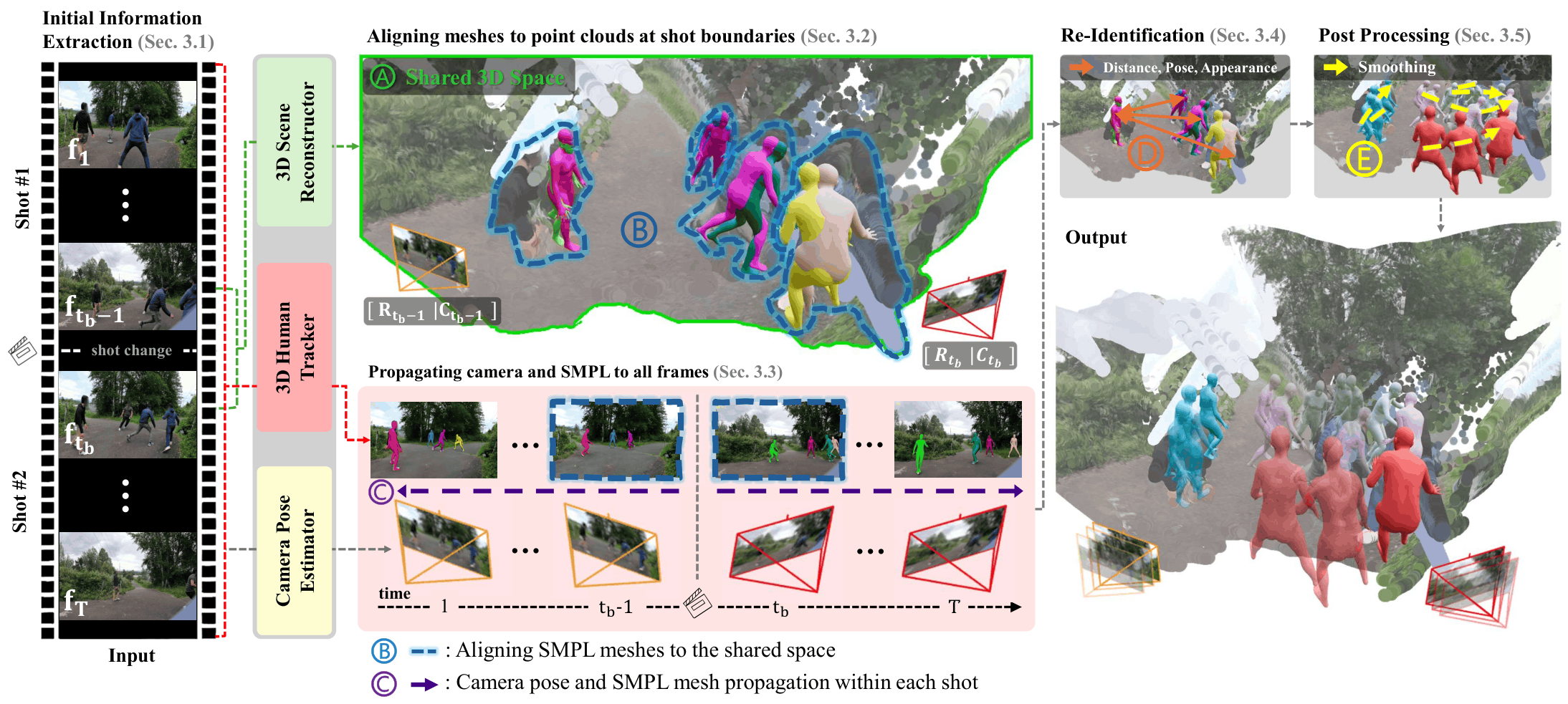
A 150-frame 1920×1080 video takes about 10 minutes on a single NVIDIA RTX 3090.
Quantitative Results
Multi-shot benchmarks built by inserting shot boundaries into the multi-view sequences of EgoHumans, EgoBody, and Harmony4D. Lower is better unless marked ↑. The best value in each column is bold.
3D human pose
| Dataset | Method | W-MPJPE ↓ | WA-MPJPE ↓ | MPJPE ↓ | MPVPE ↓ | Accel ↓ |
|---|---|---|---|---|---|---|
| EgoHumans | Multishot | 474.1 | 287.4 | 347.1 | 408.2 | 63.15 |
| GVHMR | 404.8 | 204.7 | 287.4 | 371.4 | 59.0 | |
| PromptHMR | 1778.2 | 440.9 | 285.3 | 364.1 | 74.3 | |
| HSfM† | 544.2 | 187.7 | 263.1 | 294.3 | 48.7 | |
| Ours | 279.0 | 166.0 | 228.3 | 262.2 | 27.3 | |
| EgoBody | Multishot | 185.1 | 144.1 | 147.1 | 166.5 | 17.9 |
| GVHMR | 174.0 | 133.3 | 108.0 | 147.1 | 14.7 | |
| PromptHMR | 1228.1 | 395.3 | 99.0 | 133.9 | 17.4 | |
| HSfM† | 113.1 | 96.3 | 113.3 | 123.2 | 10.9 | |
| Ours | 99.2 | 72.8 | 72.0 | 94.9 | 6.0 | |
| Harmony4D | Multishot | 248.0 | 231.6 | 511.2 | 609.5 | 37.1 |
| GVHMR | 244.9 | 166.7 | 244.7 | 334.1 | 29.6 | |
| PromptHMR | 1746.3 | 399.8 | 675.7 | 746.0 | 66.8 | |
| HSfM† | 372.0 | 178.4 | 225.6 | 257.6 | 28.3 | |
| Ours | 221.0 | 116.9 | 215.9 | 278.3 | 17.4 |
W-MPJPE aligns only the first frame and measures trajectory consistency; WA-MPJPE aligns the whole trajectory; Accel measures temporal smoothness. HSfM† is HSfM adapted to the multi-shot, multi-person setting.
Identity switches and camera pose
| Method | Identity switches (IDs) ↓ | Camera pose (ATE) ↓ | ||||
|---|---|---|---|---|---|---|
| EgoHumans | EgoBody | Harmony4D | EgoHumans | EgoBody | Harmony4D | |
| VGGT | – | – | – | 1.4 | 1.3 | 1.4 |
| PromptHMR | 10.40 | 1.29 | 8.00 | 2.3 | 1.6 | 2.3 |
| HSfM† | 3.87 | 0.20 | 1.58 | 2.8 | 2.9 | 3.2 |
| KPR | 2.54 | 0.05 | 1.19 | – | – | – |
| Pose2ID | 4.62 | 0.72 | 1.32 | – | – | – |
| Ours (dist.) | 1.66 | 0.00 | 0.54 | – | – | – |
| Ours | 0.97 | 0.00 | 0.46 | 0.7 | 0.1 | 0.7 |
IDs counts identity switches across the shot boundary; ATE is the absolute trajectory error of the estimated cameras. Ours (dist.) uses only the 3D distance term for re-identification. – means not reported.
Edited real videos
| Method | PCK* ↑ | Jitter ↓ | FS ↓ |
|---|---|---|---|
| PromptHMR | 62.7 | 162.44 | 23.11 |
| Ours | 90.7 | 31.5 | 10.7 |
AVA, Friends, and The Big Bang Theory, which contain real shot changes and no 3D ground truth. PCK* is cross-shot PCK; FS is foot sliding.
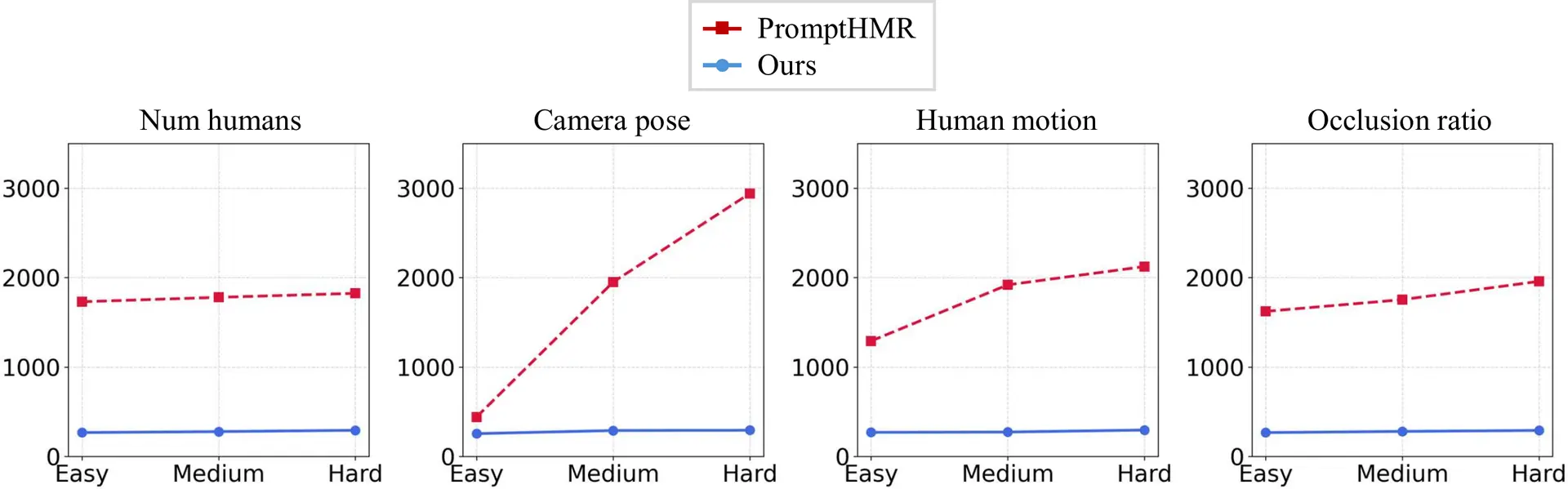
Robustness to harder scenes
Qualitative Results
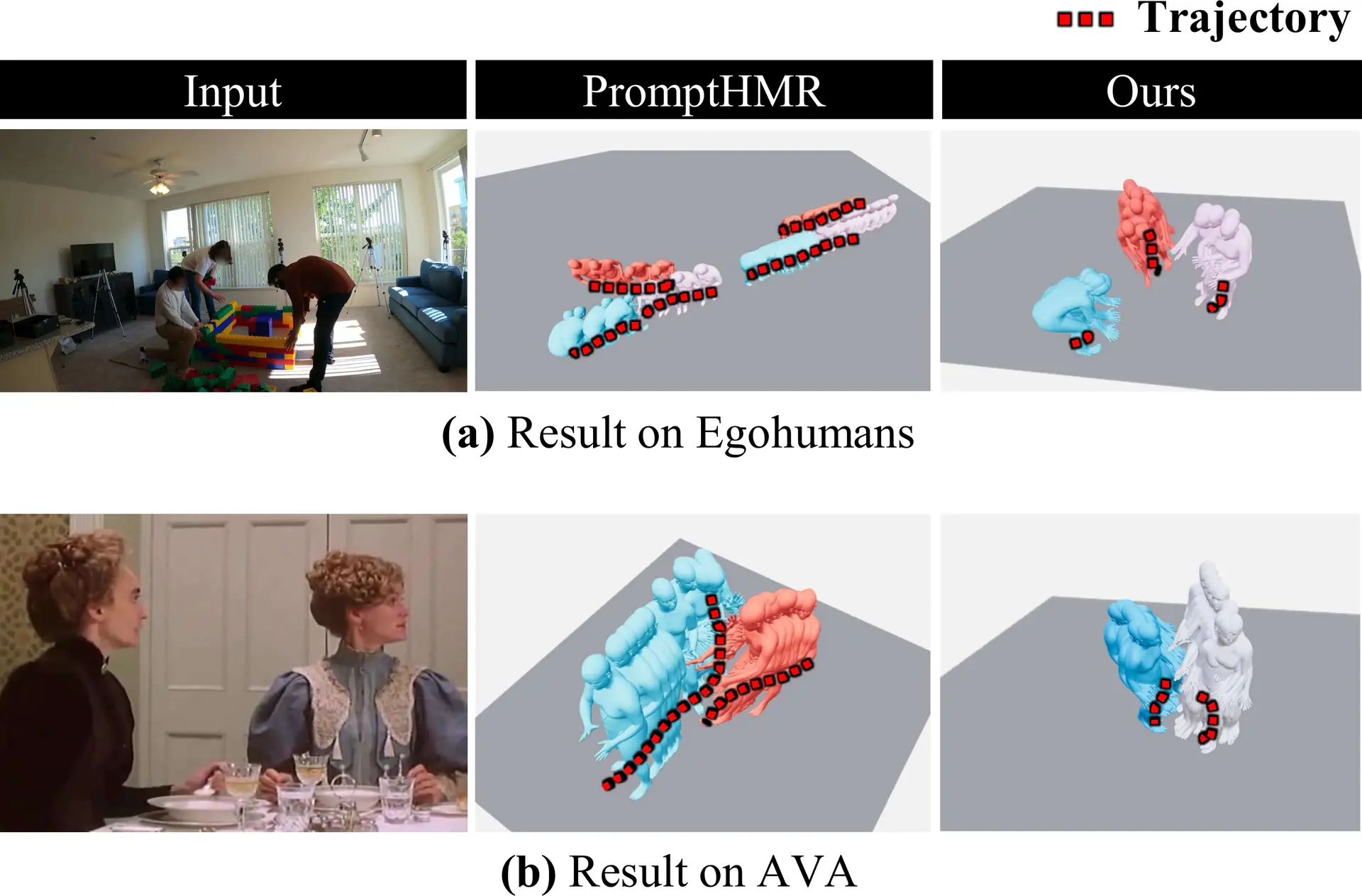
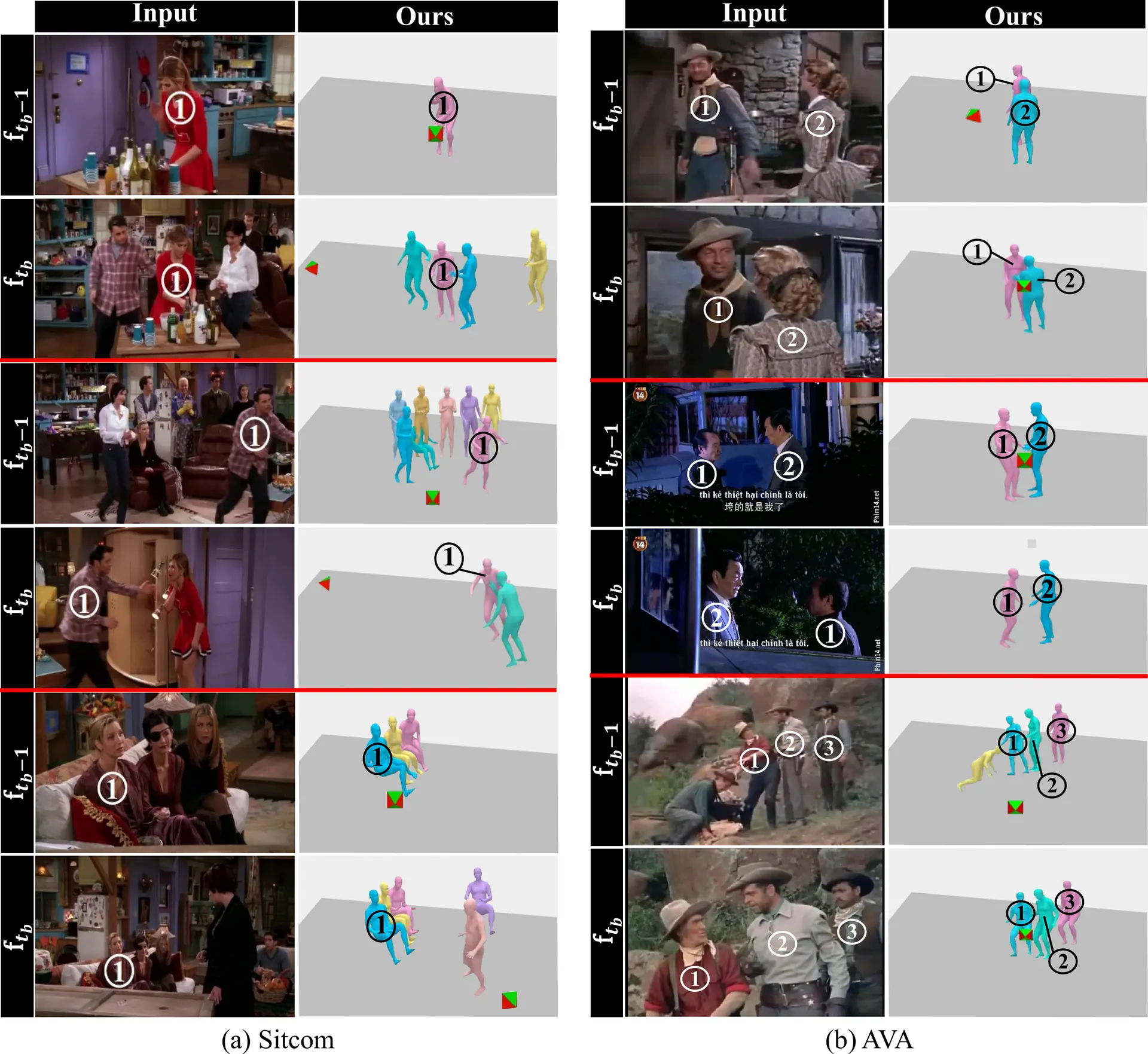
Comparisons with PromptHMR and appearance-based re-identification at shot boundaries.
Video results
Challenging cases
Global trajectories
Cross-shot re-identification
More results
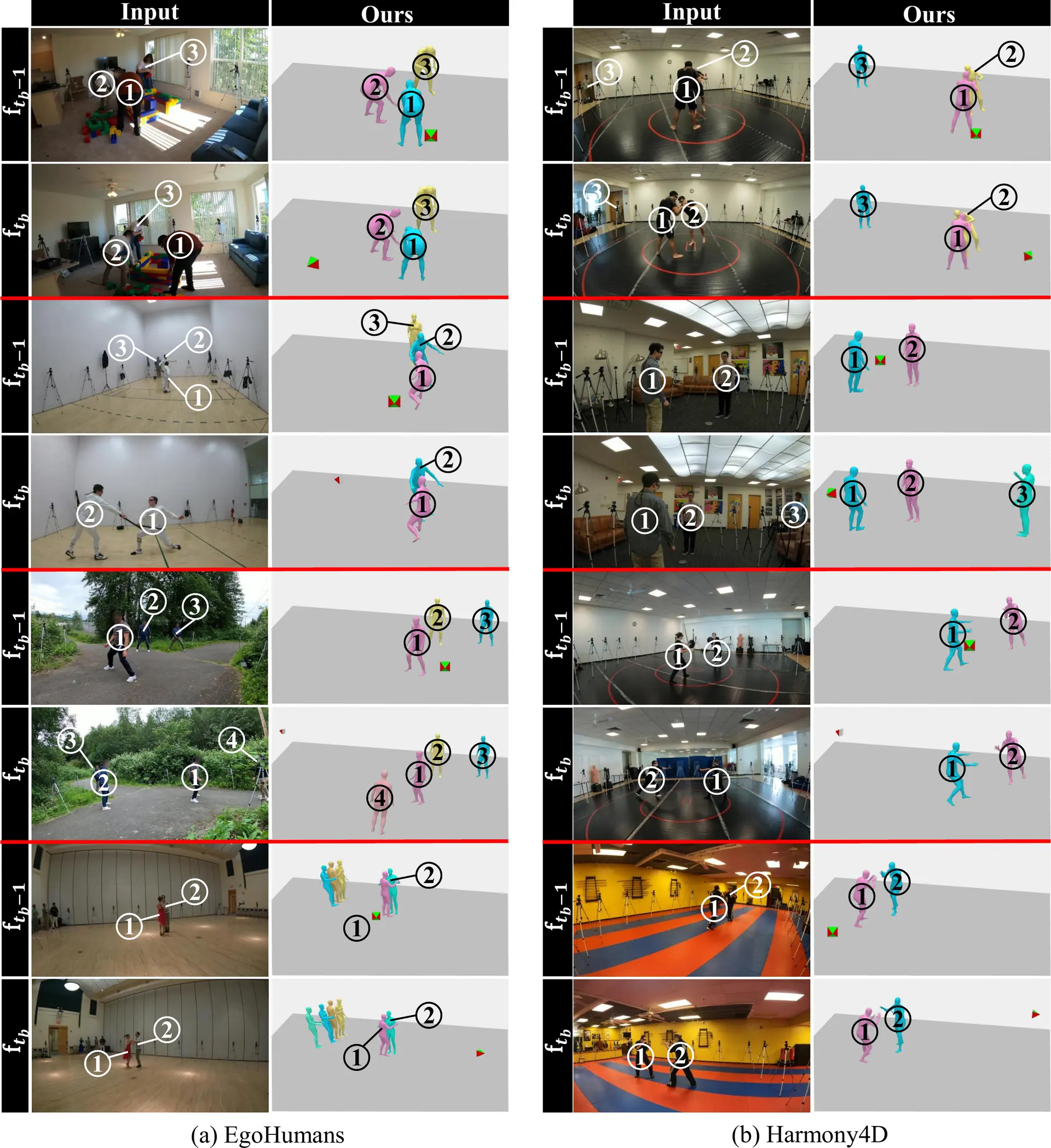
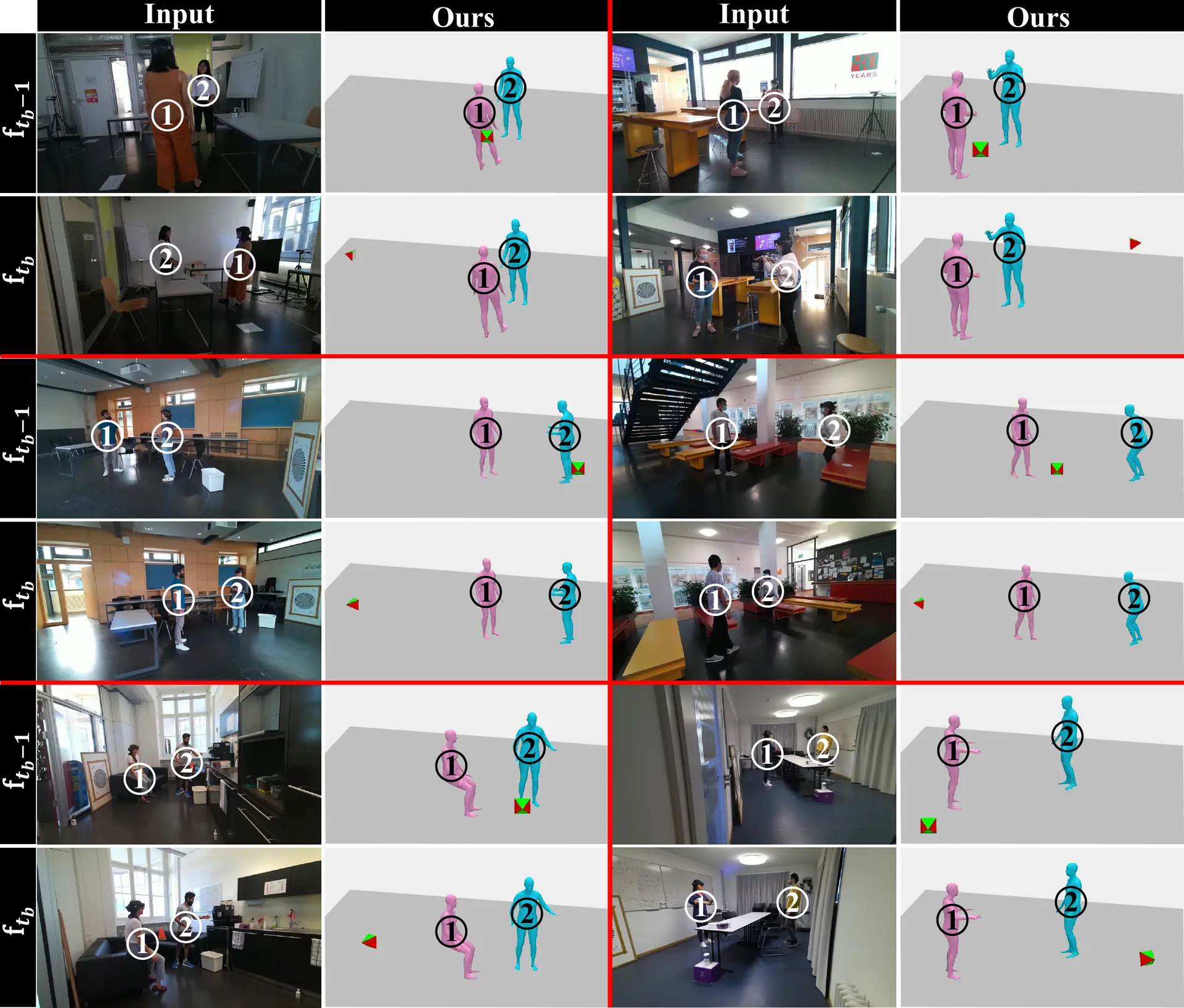
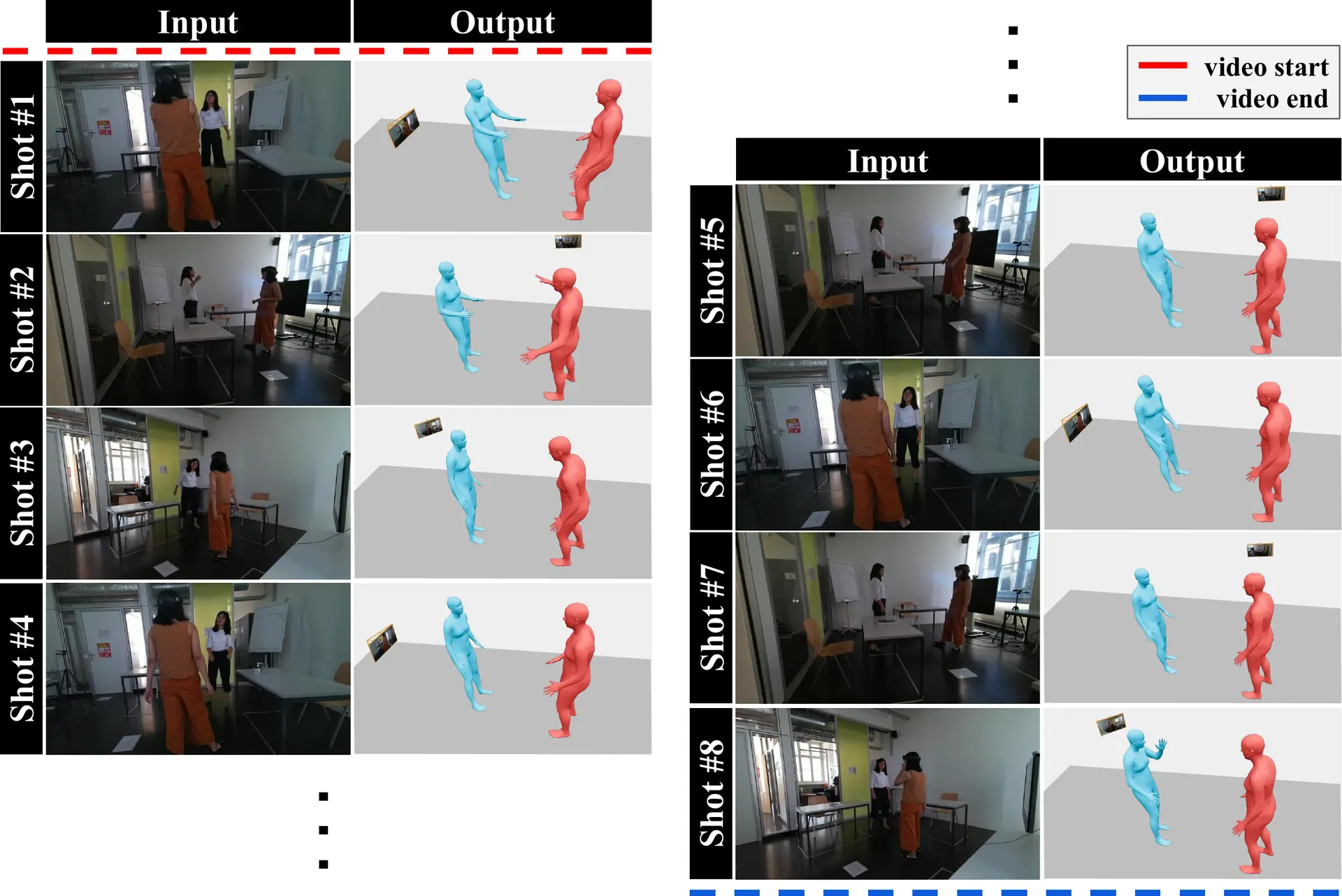
Ablation Study
Removing each component on EgoHumans.
| Method | W-MPJPE ↓ | MPJPE ↓ | MPVPE ↓ | Accel ↓ | ATE ↓ |
|---|---|---|---|---|---|
| w/o cam | 389.7 | 230.1 | 264.7 | 33.7 | 1.40 |
| w/o post | 311.2 | 241.6 | 298.3 | 47.9 | 0.77 |
| w/o stage | 491.9 | 368.1 | 359.4 | 33.9 | 2.75 |
| w/o align | 882.7 | 422.4 | 392.1 | 34.9 | 1.40 |
| Ours | 278.8 | 228.3 | 262.1 | 27.3 | 0.77 |
- w/o cam (no camera pose refinement): camera error and pose errors both rise.
- w/o post (no post-processing): Accel jumps from 27.3 to 47.9, so trajectories lose their smoothness.
- w/o stage (one-shot instead of staged optimization): every metric gets worse.
- w/o align (no human–scene alignment): the largest drop, with W-MPJPE rising from 278.8 to 882.7.
Acknowledgements
This work is supported by NRF grants (No. RS-2025-00521013 20%, No. RS-2025-02216916 10%) and IITP grants (No. RS-2020-II201336 Artificial intelligence graduate school program(UNIST) 10%; No. RS-2025-25442824 AI Star Fellowship Program(UNIST) 10%), funded by the Korean government (MSIT). This work is supported by CJ Corporation 50%.
BibTeX
@inproceedings{on2026multi,
  title={Multi-THuMBS: Multi-person Tracking of 3D Human Meshes Beyond Video Shots},
  author={On, Jeongwan and Ali, Muhammad Salman and Khan, Muneeb A and Park, Sunwoo and Moon, Inwoong and Chang, Hyung Jin and Kim, Jaekwang and Ha, Seong Jong and Baek, Seungryul},
  booktitle={European Conference on Computer Vision},
  pages={1--18},
  year={2026},
  organization={Springer}
}