BIGS: Bimanual Category-agnostic Interaction Reconstruction from Monocular Videos via 3D Gaussian Splatting
Ulsan National Institute of Science and Technology (UNIST)

CVPR 2025
TL;DR BIGS reconstructs two hands and an unknown object from a monocular video as 3D Gaussians, sharing one hand Gaussian across both hands and using a diffusion prior to recover object parts hidden by occlusion.
Video
Abstract
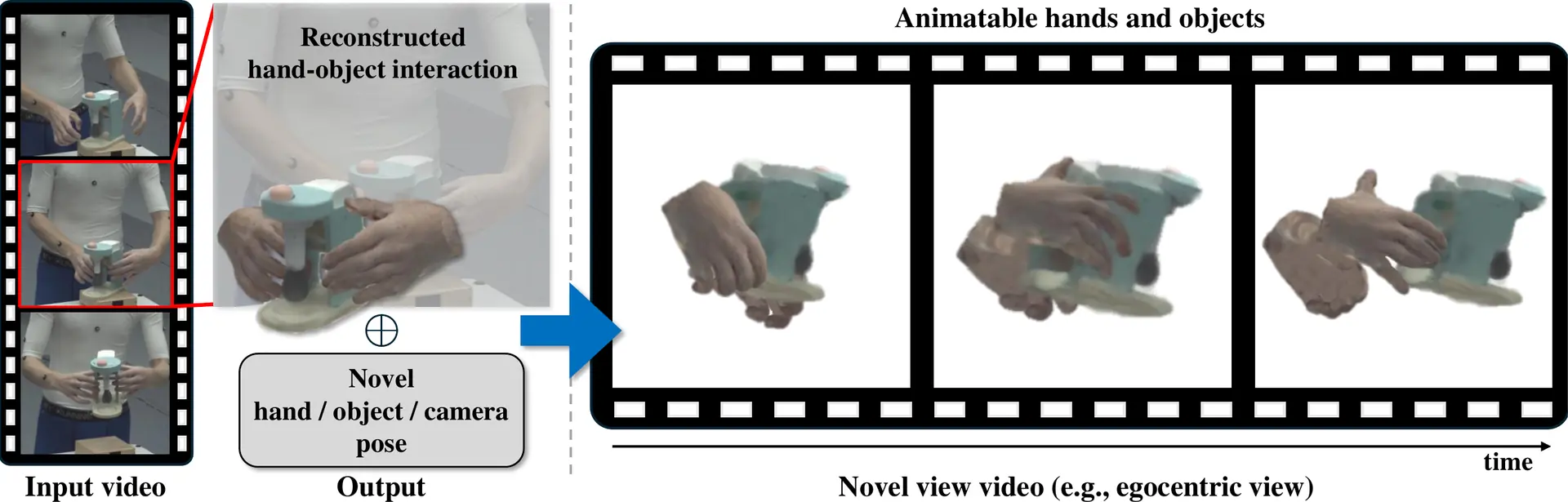
Reconstructing 3Ds of hand-object interaction (HOI) is a fundamental problem that can find numerous applications. Despite recent advances, there is no comprehensive pipeline yet for bimanual class-agnostic interaction reconstruction from a monocular RGB video, where two hands and an unknown object are interacting with each other. Previous works tackled the limited hand-object interaction case, where object templates are pre-known or only one hand is involved in the interaction. The bimanual interaction reconstruction exhibits severe occlusions introduced by complex interactions between two hands and an object. To solve this, we first introduce BIGS (Bimanual Interaction 3D Gaussian Splatting), a method that reconstructs 3D Gaussians of hands and an unknown object from a monocular video. To robustly obtain object Gaussians avoiding severe occlusions, we leverage prior knowledge of pre-trained diffusion model with score distillation sampling (SDS) loss, to reconstruct unseen object parts. For hand Gaussians, we exploit the 3D priors of hand model (i.e., MANO) and share a single Gaussian for two hands to effectively accumulate hand 3D information, given limited views. To further consider the 3D alignment between hands and objects, we include the interacting-subjects optimization step during Gaussian optimization. Our method achieves the state-of-the-art accuracy on two challenging datasets, in terms of 3D hand pose estimation (MPJPE), 3D object reconstruction (CDh, CDo, F10), and rendering quality (PSNR, SSIM, LPIPS), respectively.
Contributions
-
Bimanual 3DGS pipeline
Reconstructs the 3D interaction of two hands and an unknown object from a monocular video with 3D Gaussian splatting.
-
Two-step optimization
Hand and object Gaussians are first optimized separately for reliable shapes, then jointly so their contact is taken into account.
-
Priors against occlusion
An SDS loss with a diffusion prior fills in unseen object surfaces, and one canonical hand Gaussian shared by both hands accumulates hand information.
Why Bimanual Interaction Is Hard
Reconstructing hands and objects is essential for AR/VR, robotics, and human-computer interaction, but most methods assume a known object or a single hand. With two hands and an unknown object seen from one camera, no existing pipeline covered the whole problem.
-
Templates do not scale
Many methods need a pre-scanned object template, which typically restricts them to 10 to 20 known shapes.
-
One hand, or many views
Category-agnostic methods mostly handle one hand. HOLD is NeRF-based and slow to fit and render; MANUS needs multi-view images.
-
Severe occlusion
When two hands hold an object, occlusion patterns become dramatic and many hand and object pixels are never observed.
Method
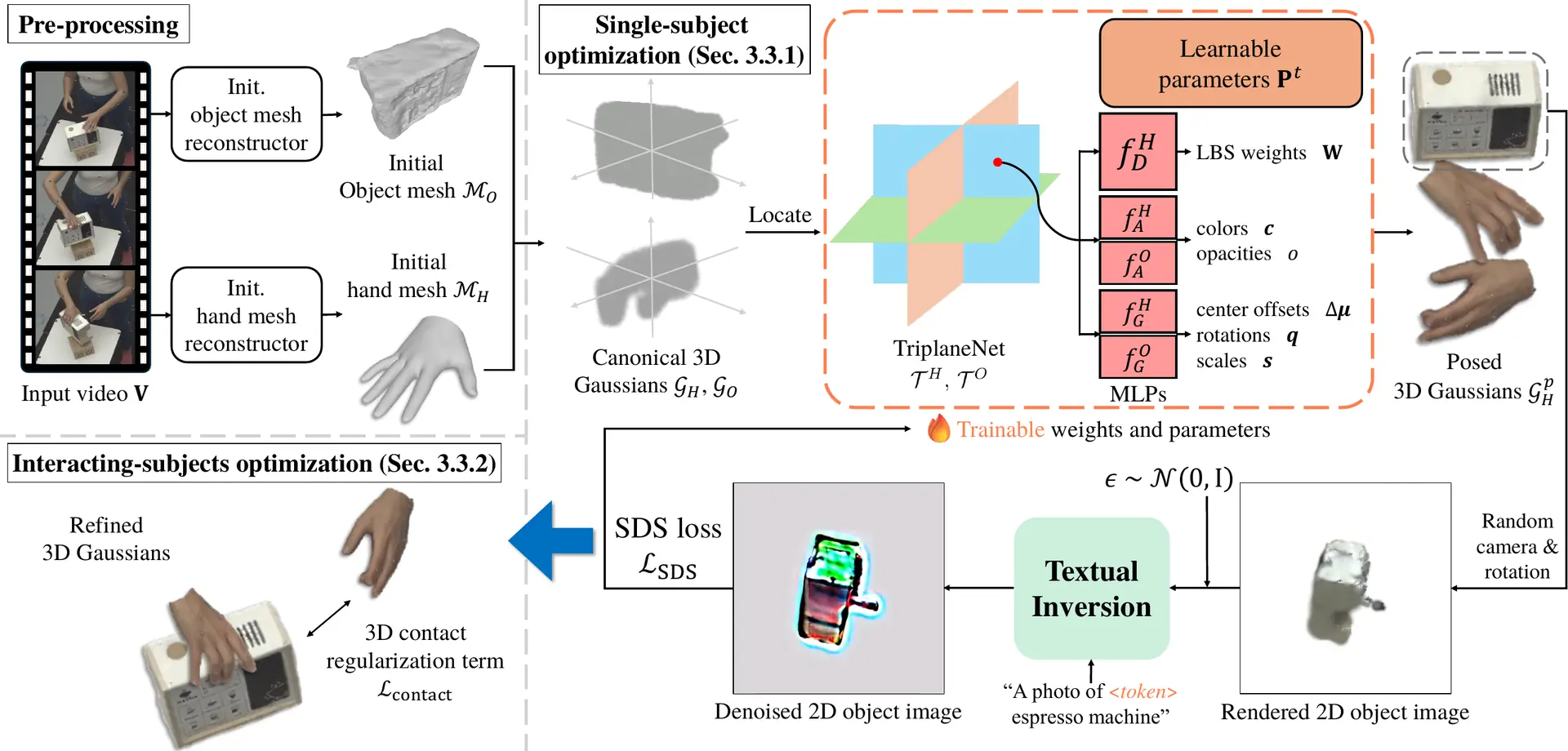
Given a monocular video, BIGS first reconstructs initial hand meshes and an object point cloud. In the single-subject optimization, hand and object Gaussians are optimized separately in a canonical space through TriplaneNet features and MLPs. A single right-hand Gaussian is mirrored to serve both hands, and an SDS loss with a text-to-image diffusion prior reconstructs object surfaces the camera never sees. The interacting-subjects optimization then refines the hand translations with a contact term so the hands and the object stay aligned.
Quantitative Results
Lower is better unless marked ↑. The best value in each column is bold.
Two hands: ARCTIC
| Method | Contact | Hand / object | ||||
|---|---|---|---|---|---|---|
| CDl ↓ | CDr ↓ | CDo ↓ | F10 ↑ | MPJPEl ↓ | MPJPEr ↓ | |
| HLoc | N/A | N/A | 4.24 | 40.57 | N/A | N/A |
| HaMeR | N/A | N/A | N/A | N/A | 27.23 | 24.37 |
| HOLD | 105.92 | 123.54 | 2.07 | 63.92 | 27.13 | 24.70 |
| Ours | 46.11 | 31.28 | 1.28 | 83.93 | 24.63 | 24.35 |
CDl and CDr are hand-relative Chamfer distances (cm²) for contact; CDo (cm²) and F10 (F-score at 10 mm, %) measure object shape; MPJPE (mm) measures hand pose. N/A: the method does not estimate that quantity. Setting of the ECCV 2024 HANDS workshop challenge.
One hand: HO3D v3
| Setting | Method | Contact | Hand / object | ||
|---|---|---|---|---|---|
| CDr ↓ | CDo ↓ | F10 ↑ | MPJPEr ↓ | ||
| Full view | HOMan | 78.2 | N/A | N/A | 32.0 |
| iHOI | 75.8 | 3.8 | 41.7 | 38.4 | |
| DiffHOI | 68.8 | 4.3 | 43.8 | 32.3 | |
| HOLD | 11.3 | 0.4 | 96.5 | 24.2 | |
| Ours | 11.1 | 0.3 | 96.7 | 23.9 | |
| Limited view | HOLD | 95.63 | 3.39 | 74.90 | 24.96 |
| Ours | 21.70 | 1.24 | 84.02 | 24.22 | |
Limited view keeps 25% of the frames of each sequence, so the object is never seen from all sides. HOLD drops sharply in this setting, while ours stays close to its full-view accuracy.
Rendering quality
| Setting | Method | PSNR ↑ | SSIM ↑ | LPIPS ↓ |
|---|---|---|---|---|
| Two-hand | HOLD | 12.83 | 0.66 | 0.32 |
| Ours | 24.87 | 0.96 | 0.05 | |
| One-hand | HOLD | 16.20 | 0.74 | 0.21 |
| Ours | 24.51 | 0.92 | 0.07 |
Our 3DGS-based method renders better than the NeRF-based HOLD in both the two-hand and one-hand settings.
Qualitative Results
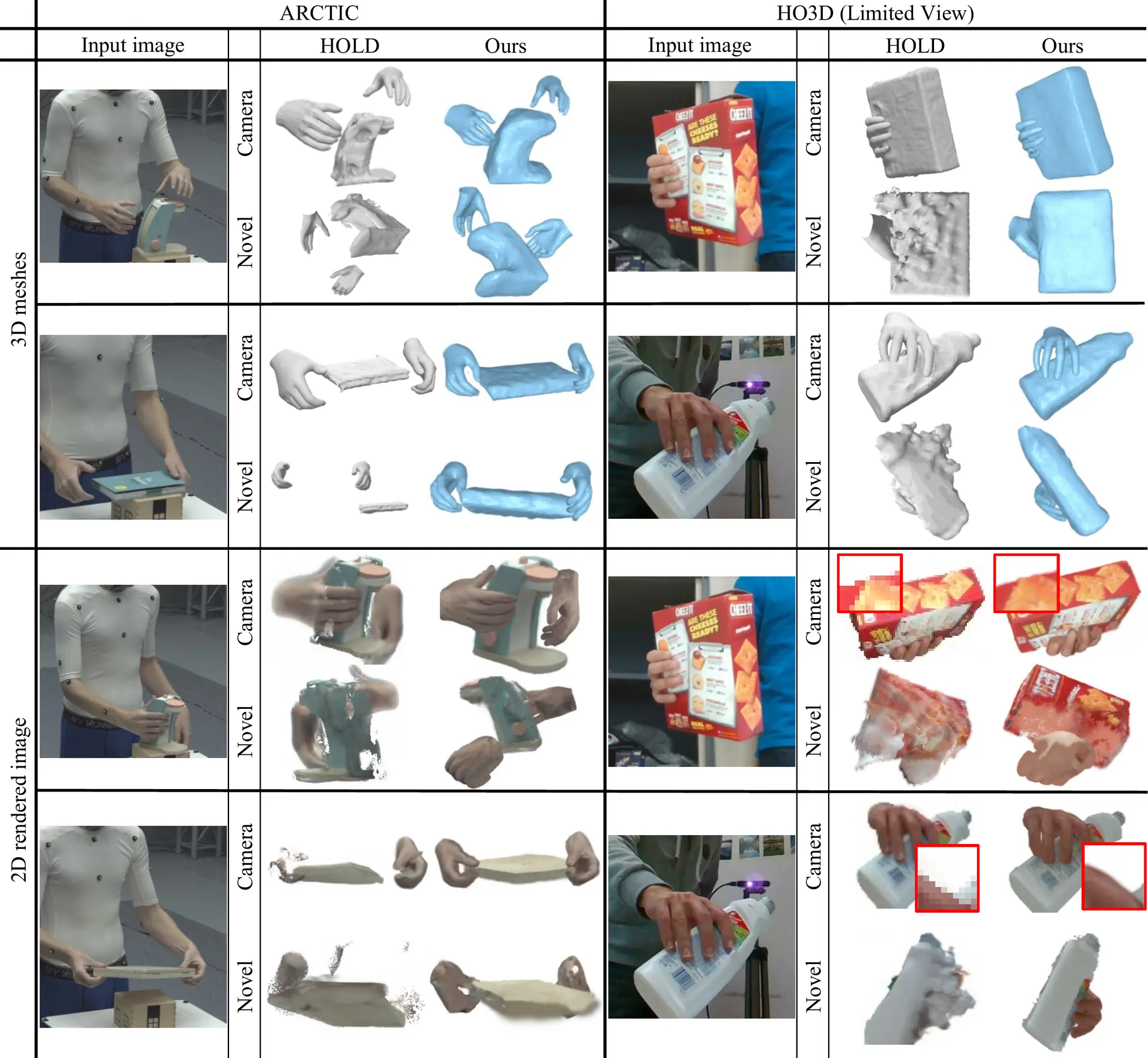
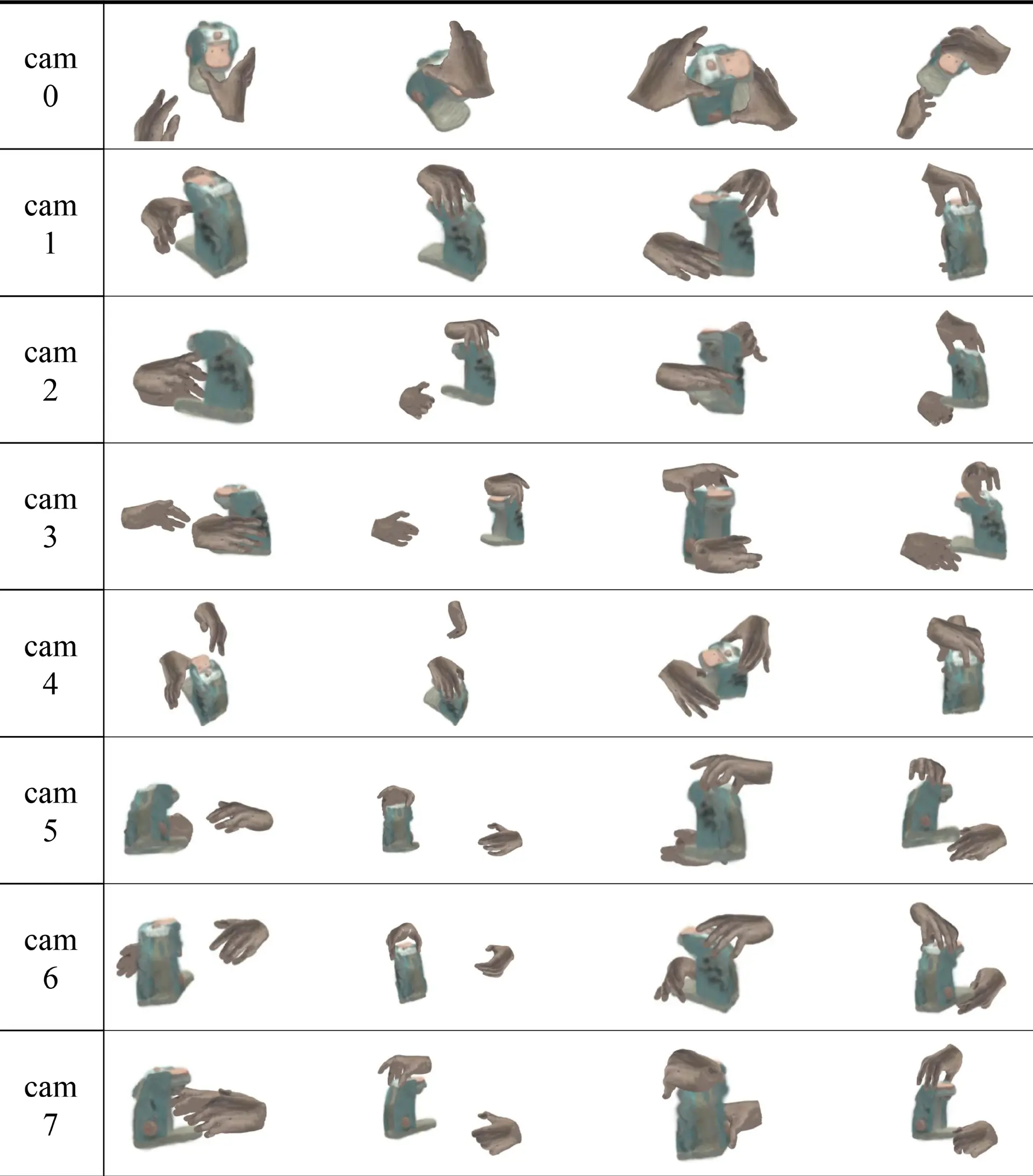
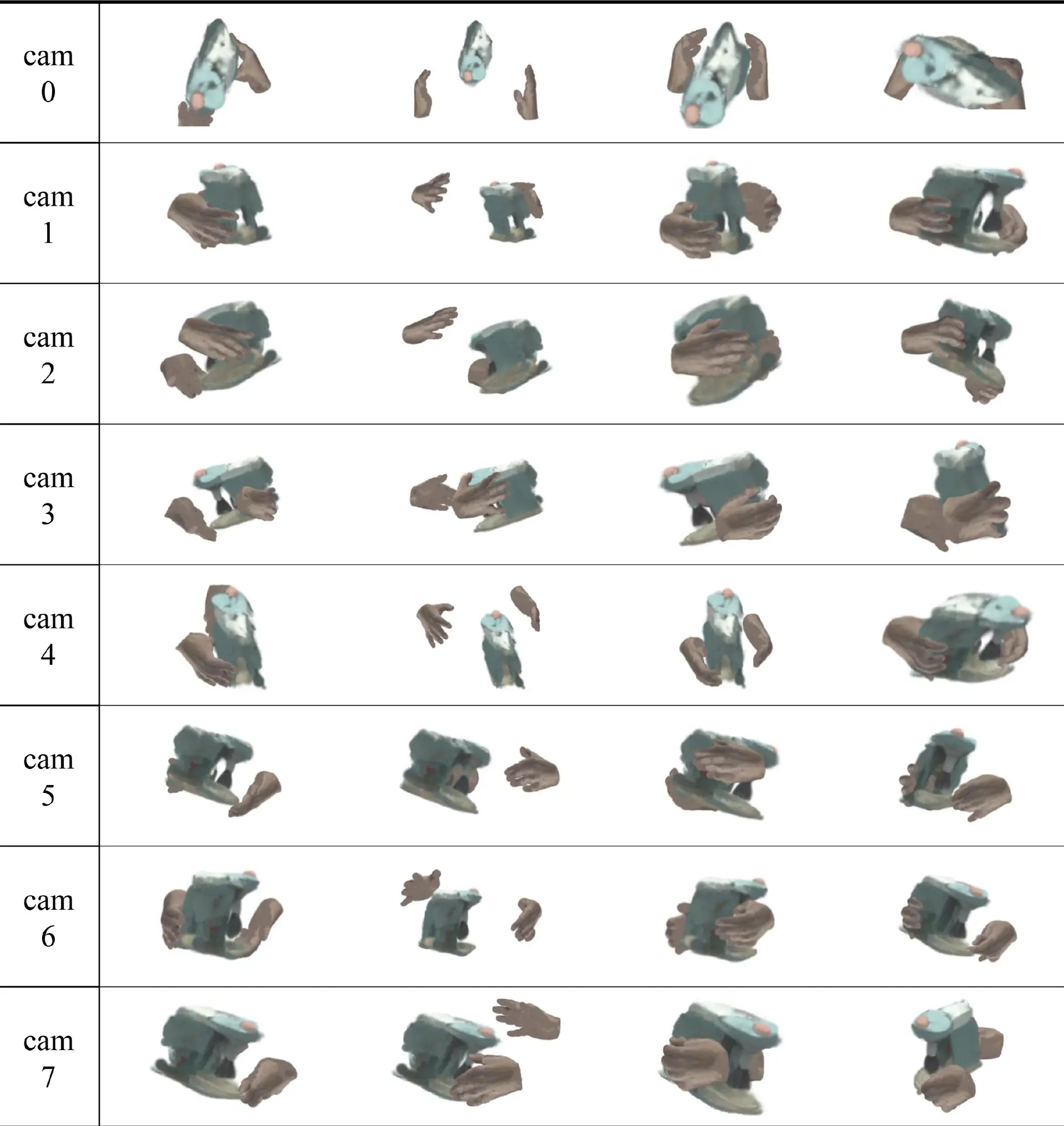
Comparisons with HOLD, and rendering with novel poses.
3D meshes and rendered images
Animatable hands and objects
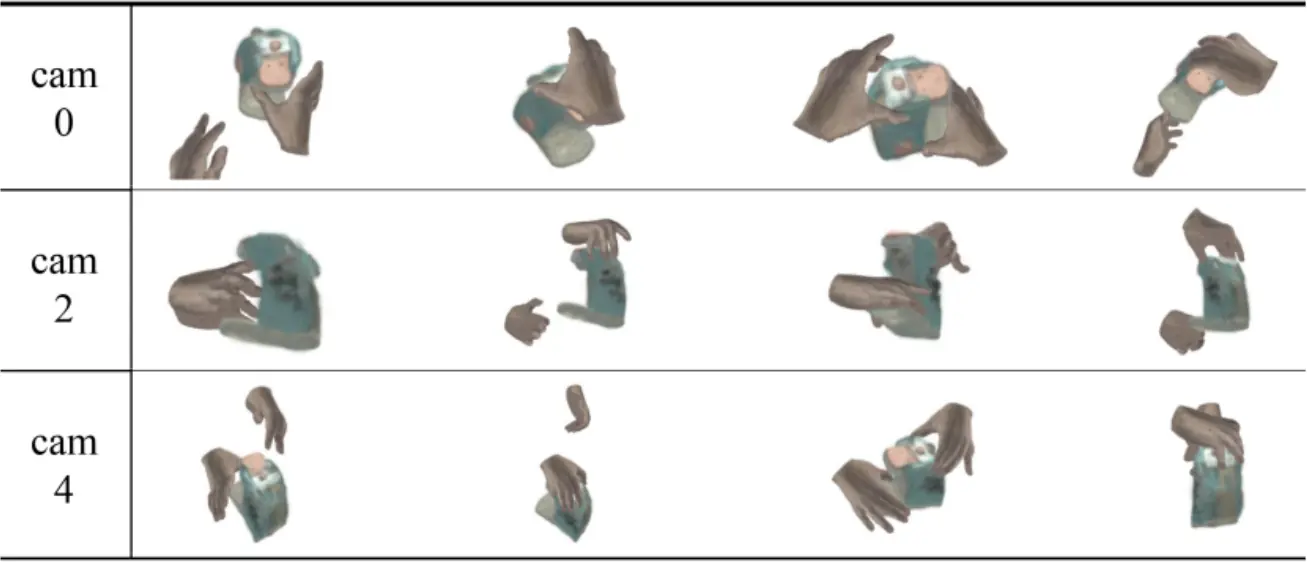
More results
Ablation Study
Turning each component on in turn, on ARCTIC.
| Components | Contact | Hand / object | |||||||
|---|---|---|---|---|---|---|---|---|---|
| LSDS | Lcontact | Lsmt | Share | CDl ↓ | CDr ↓ | CDo ↓ | F10 ↑ | MPJPEl ↓ | MPJPEr ↓ |
| 96.56 | 117.72 | 1.36 | 81.78 | 27.22 | 25.08 | ||||
| ✓ | 96.55 | 117.72 | 1.36 | 81.78 | 27.01 | 24.42 | |||
| ✓ | ✓ | 83.14 | 96.95 | 1.36 | 81.78 | 24.63 | 24.35 | ||
| ✓ | ✓ | ✓ | 50.78 | 35.57 | 1.36 | 81.78 | 24.63 | 24.35 | |
| ✓ | ✓ | ✓ | ✓ | 46.11 | 31.28 | 1.28 | 83.93 | 24.63 | 24.35 |
- Share (one canonical Gaussian for both hands) and Lsmt (temporal smoothness) improve hand accuracy (MPJPE).
- Lcontact improves contact reconstruction: CDl 83.14 → 50.78 and CDr 96.95 → 35.57.
- LSDS improves both contact and object reconstruction: CDo 1.36 → 1.28 and F10 81.78 → 83.93.
Acknowledgements
This work is supported by NRF grant (No. RS-2025-00521013 50%) and IITP grants (No. RS-2020-II201336 Artificial intelligence graduate school program (UNIST) 15%; No. RS-2021-II212068 AI innovation hub 15%; No. RS-2022-II220264 Comprehensive video understanding and generation with knowledge-based deep logic neural network 20%), funded by the Korean government (MSIT).
BibTeX
@InProceedings{On_2025_CVPR,
    author    = {On, Jeongwan and Gwak, Kyeonghwan and Kang, Gunyoung and Cha, Junuk and Hwang, Soohyun and Hwang, Hyein and Baek, Seungryul},
    title     = {BIGS: Bimanual Category-agnostic Interaction Reconstruction from Monocular Videos via 3D Gaussian Splatting},
    booktitle = {Proceedings of the Computer Vision and Pattern Recognition Conference (CVPR)},
    month     = {June},
    year      = {2025},
    pages     = {17437-17447}
}